
Issuance frameworks in tokenization have matured. Service providers now exist across custody, issuance, compliance, and blockchain infrastructure, allowing capable teams with sufficient capital and expertise to bring tokenized assets to market faster than ever.
This is an important milestone, but it also changes the basis of competition. The question worth asking now is what happens after issuance and which real-world asset (RWA) businesses will still be trusted, integrated, and operating ten years from now.
What On-Chain Finance Needs Next
The first phase of on-chain finance largely solved the technical challenge of moving value globally, instantly, and continuously. The industry has since become increasingly sophisticated at building financial applications around existing assets. As on-chain finance matures, the asset base supporting those applications will need to broaden alongside it.
Today, much of that foundation is built around the U.S. dollar and dollar-denominated stablecoins. As the market expands, high-quality real-world assets can complement this foundation with a broader base of credible reserve assets. This is the Reserve Layer that Matrixdock is building: an infrastructure connecting these assets with the verification, liquidity and operational systems required for their on-chain use.
A reserve asset is consistently verifiable, reliably priced, and capable of functioning at scale. But those qualities depend on more than the underlying asset itself. They also depend on the operational infrastructure surrounding it.
Building the Reserve Layer, therefore, depends on two dimensions: the suitability of the underlying asset and the operational capability of the issuer.
Dimension One: Assets That Can Serve As Reserves
An asset can be valuable without being suitable as a reserve asset. A reserve asset needs a high degree of certainty around its value: its price should be independently observable, its characteristics sufficiently standardized, and its underlying market deep enough to support reliable pricing and liquidity at scale.
Infrastructure-Grade Assets: Reserve Assets Built for Financial Infrastructure
Assets like short-term U.S. Treasuries, physical gold and silver, and money market instruments are well suited to this certainty. They benefit from established markets, recognizable standards, observable pricing, and institutional processes around custody and settlement. These characteristics can make verification, liquidity management, and integration more repeatable.
Non-Standardized Assets: Less Suitable As Reserve Assets
Conversely, assets like private credit present a more nuanced case. It can take on standardized features like net asset value (NAV), stated yields, and structured products, while the underlying exposures remain heterogeneous and individually underwritten. Its value may need to be assessed rather than directly observed from the market, while liquidity and credit outcomes can vary across individual loans. These characteristics can make the level of certainty expected of a reserve asset harder to establish consistently.
Asset-level certainty, however, is only the starting point. Once an asset is represented on-chain, the issuer must continuously demonstrate that the infrastructure around it performs as intended.
Dimension Two: Strong Issuers Build Durable Infrastructure
Physical gold has preserved value across centuries. A token representing gold, however, depends on an operating system that must continue to function over time.
Why Operations Compound
Reserves must be managed, custody secured, verification maintained, redemptions fulfilled, liquidity sustained, and integrations kept reliable. Much of the infrastructure behind these functions can be contracted; a well-funded competitor can therefore replicate many of the operational components surrounding an asset.
However, it cannot immediately replicate the history of operating those components successfully as a system. Years of consistent reserve management, independent audits, successful redemptions, market continuity, established liquidity networks, protocol integrations, and performance across different market conditions can only be built through continued operation.
The Operations Repeat. The Evidence Accumulates.
Operational work is repetitive by nature, but the evidence it produces accumulates. Each audit adds another verification point. Each successful redemption adds evidence that the exit mechanism works. Each period of market continuity builds pricing and liquidity history. Each integration extends the asset’s utility within the broader financial system. Together, these form an increasingly substantial operating track record.
A longer track record provides institutions a deeper body of evidence with which to conduct their own due diligence. Over time, that evidence can support broader distribution and liquidity, which can in turn expand collateral utility and integration across financial applications. Each new use case generates further market and operating history, reinforcing the cycle. The operations repeat, the evidence accumulates, and the advantage compounds.
Consider the operational infrastructure surrounding Matrixdock’s tokenized gold, XAUm. Recurring semi-annual independent reserve audits have established a consistent record of verification, while continued ecosystem expansion added over 20 integrations in the first half of 2026 alone. Neither represents an advantage in isolation; the advantage is the accumulated evidence of continuous operation at scale.
Why Both Dimensions Matter
The interaction between asset readiness and operational capability creates four possible outcomes.
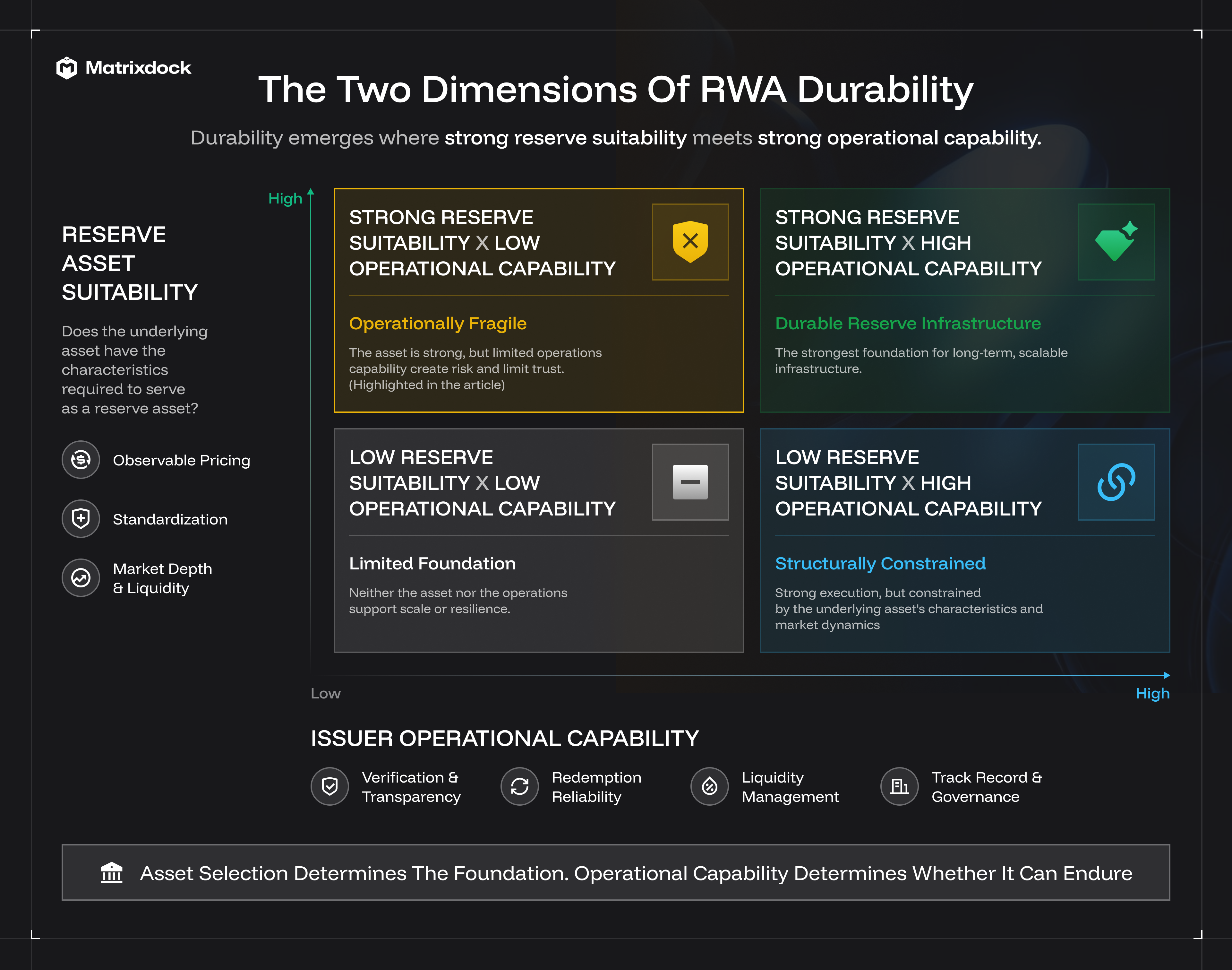
Three of the four combinations are easy to reason about. A weak asset with a less-established issuer lacks both a reserve asset and the operational capability to support it at scale. A weak asset with a strong issuer performs better than it otherwise would, but operational excellence cannot fundamentally change the characteristics of the underlying asset; the ceiling is set by the asset itself. A strong asset paired with a strong issuer creates the strongest foundation for long-term durability. Both dimensions reinforce each other as operational evidence accumulates, confidence strengthens, and institutional utility grows into durable advantage.
The Trap: Strong Asset x Limited Issuer Track Record
This combination deserves the most attention, as it is the least obvious and potentially most consequential. Gold and Treasuries come with established markets, institutional familiarity, and long histories as financial assets. These characteristics can create an initial sense of security around their tokenized forms, even when the issuer has yet to build an equivalent operating track record.
The quality of the reserve and the quality of the infrastructure representing it are separate questions. The difference becomes visible in the operational details: whether audit cadence holds when it is inconvenient, whether redemptions are tested at scale rather than assumed, whether insurance and vaulting arrangements are renewed on schedule, and whether compliance keeps pace as jurisdictions change their rules.
Under normal market conditions, that difference may be less visible. It becomes more consequential during periods of volatility, large redemptions, liquidity stress, or operational disruption when the infrastructure around the asset is tested more directly.
Beyond Issuance
Tokenization creates representation. Asset quality creates the foundation. Consistent operations build the evidence that allows the foundation to become infrastructure.
Ten years from now, the RWA businesses still trusted, integrated, and operating will likely be those that pair reserve assets with the operational discipline to support them through changing markets. For Matrixdock, this is the foundation of the Reserve Layer: turning high-quality real-world assets into infrastructure for on-chain finance through consistent execution over time.