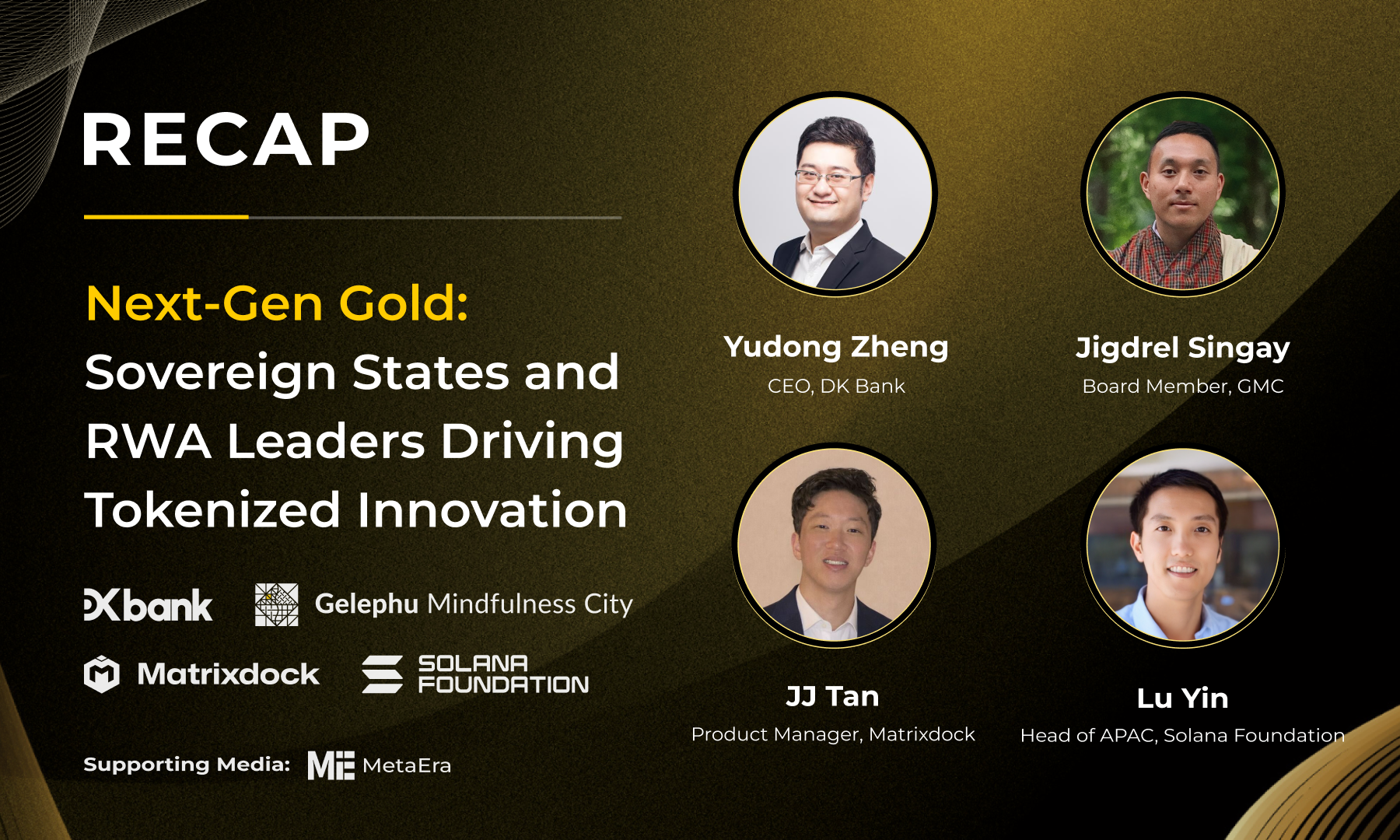
On January 28, 2026, Matrixdock, together with DK Bank, Gelephu Mindfulness City (GMC), and the Solana Foundation, hosted an online AMA titled “Next-Gen Gold: Sovereign States and RWA Leaders Driving Tokenized Innovation.”
The discussion explored how sovereign entities, regulated financial institutions, and RWA platforms are jointly advancing the development of tokenized gold as real financial infrastructure.
The AMA featured Yudong Zheng, CEO of DK Bank, Jigdrel Singay, Board Member of GMC, Lu Yin, Head of APAC at the Solana Foundation, and JJ Tan, Product Manager at Matrixdock. Drawing on perspectives from policy, banking, tokenization technology, and blockchain infrastructure, the speakers examined how tokenized gold is evolving into a scalable, usable, and resilient system within the real economy.
A Pivotal Point in the Collaborative Gold Evolution
The AMA opened with a discussion that gold tokenization is undergoing a structural transition from early initiatives to a production phase of real system building, by coordinated participation across sovereign authorities, banks, RWA platforms, and public blockchain infrastructure.
This collaborative model was exemplified by the launch of the TER project in December 2025. TER is a sovereign-backed tokenized gold project, with GMC providing policy and regulation oversight, DK Bank responsible for banking services and distribution, Matrixdock delivering tokenization technology and smart contract architecture, and Solana serving as the high-performance public blockchain infrastructure underpinning the system.
Gold’s Role and the Path of Tokenization
From a macro perspective, the speakers agreed that the recent strength in gold prices reflects not short-term speculation, but a reassessment of reserve assets amid heightened global uncertainty.
Jigdrel shared that GMC has been a sovereign pioneer in digital assets since 2019 and demonstrated belief in the long-term thesis of Bitcoin and Gold by creating a progressive financial regulatory framework. Gold remains a critical asset for managing systemic risk, while tokenization is a way to adapt gold to the operational logic of modern financial systems.
Yudong from DK Bank added that while physical gold has long served as a store of value and hedge against market and geopolitical risks, it faces inherent frictions in verification, custody, liquidity, and usability. The core value of tokenization, therefore, lies in reducing trust costs through technology.
Matrixdock further explained that by combining clear asset standards, institutional custody structures, and on-chain verifiability, tokenized gold allows authenticity and traceability to be ensured by system design rather than reliance on a single intermediary. This is a marked improvement from the traditional method of holding physical gold, which has notable risks unable to be solved with surface level mitigations.
Solana’s Role as Internet Capital Markets
Lu shared Solana’s north star as Internet Capital Markets, where access to financial services is available to everyone globally. The ability to offer commodities, in particular gold, is fundamental to the future that Solana is building with partners. The decision to deploy TER on Solana was driven by practical requirements in scalability and efficiency. Yudong from DK Bank shared that TER already has close to 100,000 holders in Bhutan with high transaction frequency, placing strong demands on throughput, cost efficiency, and network stability.
Complementary Models in a Growing Market
When discussing the current tokenized gold landscape, speakers noted that as the market has grown to a multi-billion-dollar scale, its structure has become increasingly diverse. These models were described not as competitors, but as serving different user segments. On one end are sovereign-led gold token initiatives such as TER, which emphasize state backing, financial inclusion, and broad adoption. On the other end are enterprise-issued gold tokens like XAUm, which focus on commercial use cases, composability, and institutional adoption. Together, they represent complementary pillars in the evolution of tokenized gold.
An insightful point brought up by JJ from Matrixdock was that amongst the different asset classes in RWA assets, tokenized gold in particular will develop into an eventual landscape of meaningfully differentiated issuers. Due to the physical nature of underlying physical gold, it possesses characteristics of geographical location, authenticity standards, and traceability records. Each region has different market demand, risk profiles of jurisdictions, and consumer preferences.
Tokenized Gold in the On-Chain Economy
JJ from Matrixdock highlighted that as more assets move on-chain, the on-chain economy is developing a clear need for several reserve-grade assets, enabling users to trade against, settle into, and hold as the long-term denomination. In this emerging structure, stablecoins function as transactional media, Bitcoin serves as a digital-native store of value, and tokenized gold enters the system as a physically backed, long-term hard asset. As tokenized gold gains broader institutional adoption, they become increasingly suitable for balance sheet inclusion and more fully integrated into traditional finance infrastructure.
Conclusions
In closing, the panel agreed that when sovereign states, banks, RWA platforms, and public blockchain infrastructure collaborate, the tokenized assets ecosystem is evolving into a durable form of financial infrastructure with long-term relevance and real activity. The on-chain integration of gold is opening a new asset layer for the global financial system - one designed to develop sustainably alongside both traditional and digital finance.